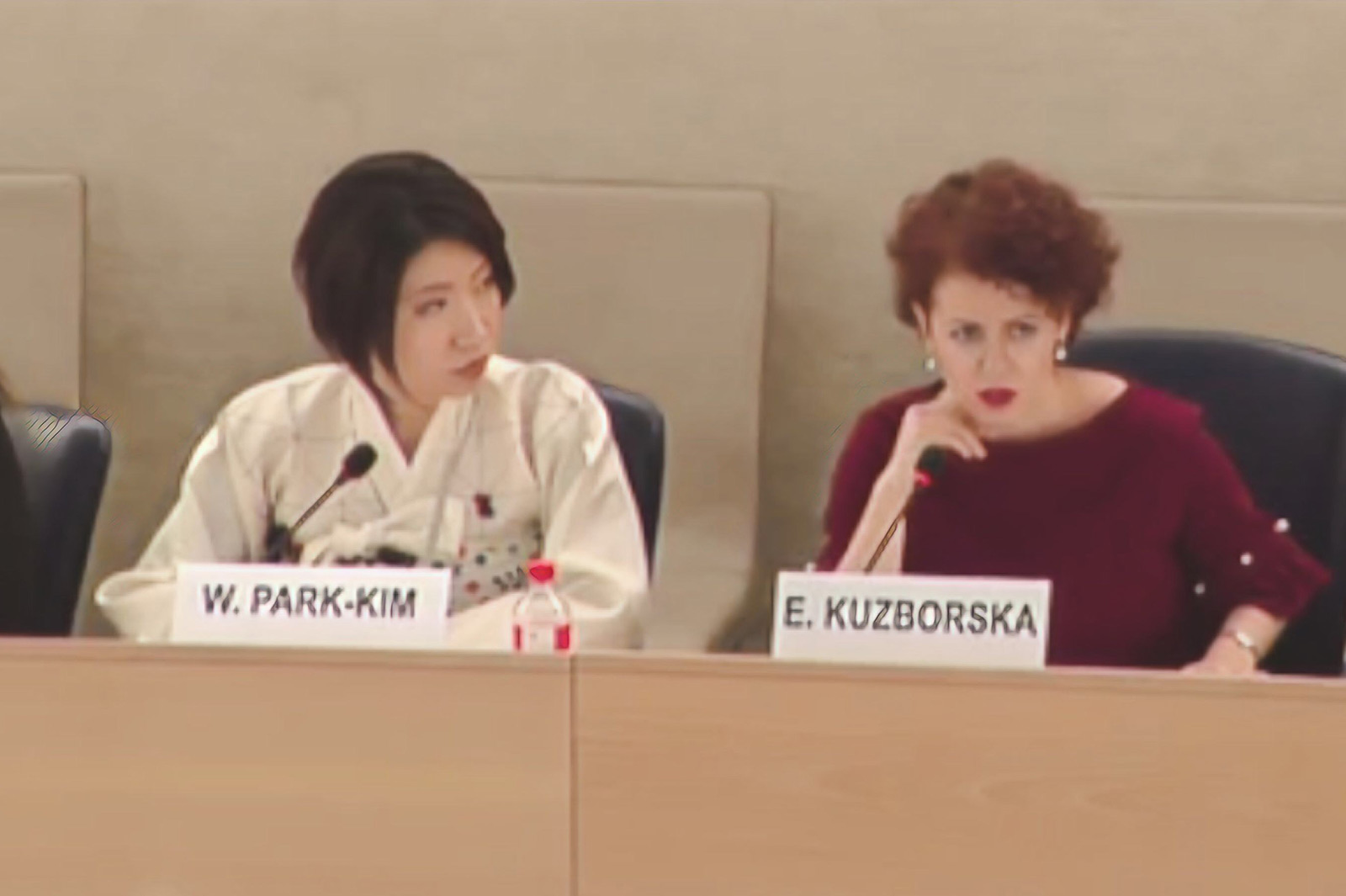

10th session of the Forum on Minority Issues
Geneva, 30th November – 1st December
“Minority youth: towards inclusive and diverse societies”
Discussion “Minority youth and education”
E. Kuzborska, 30/11/2017
Ladies and gentlemen,
Excellencies,
Representatives of civil society,
For me it is a great honour and a privilege to share with you my experience and insights concerning the importance of the right to education in a minority language.
The experience concerning primary and secondary education in mother tongue is relevant to the experience and background of most of the members of Polish minority in Lithuania. Most of my life I have lived in Lithuania. My parents are Polish and I was raised in mainly Polish environment, speaking Polish language. In short, the educational system of minorities in Lithuania for decades was oriented in favour of teaching in minority language – all subjects were taught in minority language (mostly Polish and Russian – languages of the largest minorities in the country) and the official language was taught as a separate subject. I was educated in that system and for several years I was working in one of the Lithuanian state offices, which proves my command of official language after graduating from minority school was perfect.
I am a big fan of teaching minority language and in minority language to the most extend it is possible. Introducing the teaching of the official language in minority schools step by step gives good results and empowers children.
I would also like to share my academical practice teaching in minority language. For number of years I was a lecturer at the Branch of Białystok University in Vilnius, Lithuania, educating members of Polish minority in their mother tongue. Vast majority of graduates of the University Branch take up a job in Lithuania and is successful on the labour market. This proves that educating in mother tongue even at tertiary level gives positive results and empowers members of minority. I need to emphasize that all the graduates of the Branch perfectly command the official language.
My message is what my example and experience prove – the education in mother tongue of children leads to encouragement, strength and enthusiasm, and greater academic success. The scientific basis for this is measurable and observable in all parts of the world, and goes to the very heart of inclusion and effective participation in society, especially for national minorities.
Here I would like to make 3 main points of my intervention.
First, let me say clearly that minority education involves human rights, including in relation to the language of education. Legal obligations in Europe in relation to the educational rights of national minorities are fairly strong and must be respected, though there seems to be a tendency of some states to turn a blind eye to these, especially in relation to “less popular” minorities.
Second, minority education that is culturally appropriate, including where possible in a national minority’s own language, produces good academic results.
And thirdly, national minorities integrate best when they are taught in their own languages as much as is possible.
Studies by the World Bank, UNESCO, UNICEF, and in different parts of the world, confirm that the proportionate use of the language of minorities in education, combined with quality teaching of the official language:
- Is more cost-effective in the long term.
- Reduces dropout and repetition rates.
- Leads to noticeably better academic results, particularly for girls.
- Improves levels of literacy and fluency in both the mother tongue and the official or majority language.
- Leads to greater family and community involvement and support.
The evidence is clear: children taught in their own language do better in school, and stay there longer, giving them a stronger basis in order to learn official or another languages.
Language is the key to inclusion. Language is at the center of human activity, self-expression and identity. Recognizing the primary importance that people place on their own language fosters the kind of true participation in development that achieves lasting results.
My recommendation would be to link strongly the human rights with the right to be educated in one’s own minority language as much as is reasonably possible, and this can go up to even university education where you have especially large and concentrated minorities. Thus it is crucial to promote mother tongue education of minorities among stakeholders, politicians and officials – i.a. to present advantages of minority education as an effective tool of integration within a civil society.
Thank you for your attention.
About The Author: Elżbieta Kuzborska
An expert on national minorities, lecturer and trainer, author of publications in the field of public international law and protection of human rights with the focus on the protection of the rights of national minorities.
More posts by Elżbieta Kuzborska